
Mastering Meditation
Updated: Aug 20
Inspired by a talk by Ram Dass- Adapted with attribution.
Written by Iain Beaton.
The Breath Versus the Ego
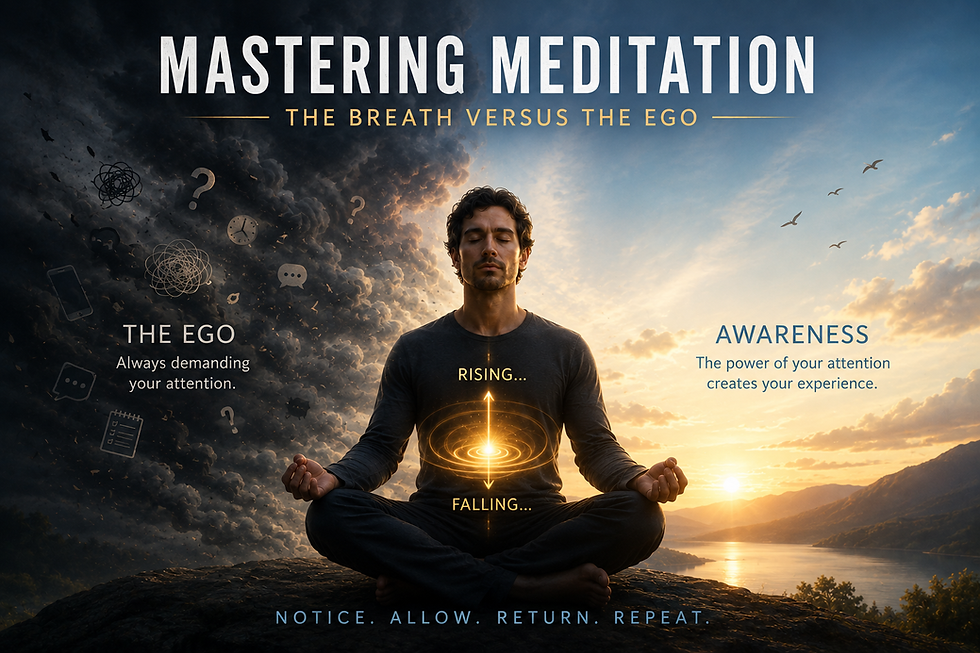
Meditation doesn't need to be mystical or complicated. One of the most profound practices begins with something incredibly simple: the breath.
Bring your attention to the gentle rising and falling of your diaphragm. Notice it...
Rising... falling... rising... falling.
Almost instantly, when we sit down to practise meditation, the mind will say, "This isn't going to work."
And that's the moment when the ego tries to grab your attention.
The practice isn't to fight the thought or force it away. Simply notice it, allow it to be there, and gently return your awareness to the breath.
Rising... falling.
Thoughts of all kinds will line up for your attention. Practical ones. Critical ones. Even spiritual ones.
"I'm hungry."
"This is silly."
And the big one...
"I think it's finally working!"
Each one is effectively saying, "I'm important. Think about me." That's the ego trying to reclaim centre stage.
If you follow the thought—if you start analysing it, debating it or becoming absorbed in it—you've already been pulled away. But if you simply notice, "Oh, that's a thought," allow it to pass and return to the breath...
Rising... falling...
...then you're practising meditation.
And the thoughts will keep coming.
"This is embarrassing. I should be doing something more important."
"I wonder if the 20 minutes is up yet."
"I'm hungry."
"My knee hurts."
Each thought demands centre stage: "I'm real. Think me."
The invitation is always the same.
Notice the thought. Allow it. Return to the rising and falling of the breath.
Watching the Stream
Over time, you may begin to experience your thoughts like leaves, sticks and other objects floating down a stream.
Normally, something catches your attention and you instinctively turn your head to follow its journey downstream. Meditation teaches us that we don't have to follow everything that passes through our awareness.
The leaf can appear.
It can float past.
And it can disappear.
You remain where you are, gently anchored to the breath.
Rising... falling.
The contents of the stream haven't necessarily stopped. What's changing is your relationship with them.
Another beautiful analogy is that of clouds moving across a vast sky.
Our thoughts are like the clouds—constantly appearing, changing shape and eventually disappearing. When we're caught up in our thinking, we move from one cloud to another, barely noticing the vastness behind them.
Meditation gradually allows us to become aware of something else:
the sky beyond the clouds.
Instead of identifying with every passing thought, we begin to recognise the awareness in which those thoughts are appearing.
"Is It Interesting?"
There's another simple technique I've been taught on my own journey towards self-mastery for when meditating.
Whenever you notice a thought stealing the main stage of your mind, simply ask:
"Is it interesting?"
And quietly answer:
"No." (The idea behind this is that the mind only focuses on what is interesting, therefor lets go of the thought)
Then return your attention to the breath.
You may be surprised by what happens. Without your attention feeding it, the intrusive thought can simply disappear, and you find yourself returning to the stillness of the breath.
Rising... falling.
Meditation Is Medication
There's an old saying: "Meditation is medication."
Not because meditation should replace appropriate professional or medical care, but because it can nurture valuable capacities within us: presence, focus, emotional balance and, perhaps most importantly, the ability to observe our thoughts without automatically being driven by them.
Those same capacities can also provide a valuable foundation for therapeutic work, including hypnotherapy.
Each time you notice that you've been carried away by a thought and gently return to the breath...
Rising... falling...
...you're practising the ability to remain present with whatever arises.
And that's a skill you can carry into everyday life.
A skill of awareness.
An awareness of something beyond the constant chatter of the thinking mind—what some might describe as our higher consciousness or higher self.
A state in which, rather than constantly doing or thinking, we simply experience being.
Start Today
I encourage you to begin a daily meditation practice today. If you struggle in the beginning, try shorter meditation of around 3-5mins.
It doesn't need to be complicated. Give yourself some time, follow the gentle rising and falling of your breath, notice when your thoughts inevitably carry you away, and then simply come back.
Again and again.
Rising... falling. Meditation is simple; the dedication to a daily practice is the hard part.
I'd love to hear what the experience is like for you. Let me know in the comments.
Thanks for reading, and please feel free to share this with anyone you think could benefit from this wisdom.
Iain 💚🙏


Comments